Our favorite ACA adviser is back in the news. Jonathan Gruber went before the House Oversight Committee on Tuesday and apologized for his comments about the "stupidity" of the American people in videos continue to serve as an anti-Obamacare wellspring. As the Democrats distanced themselves from Gruber's remarks, Elijah Cummings ended up on an unlikely tag team with Darrell Issa to berate Gruber. Although Issa denied this, you can be the judge.
A recent Vox article argues that the most substantive aspect of Gruber's comments could be his implication that subsidies were only supposed to be given in state run marketplaces. This seems to support the plaintiff's case in King v. Burwell. This case, which, on November 7th, the Supreme Court decided to review, threatens the subsidies of thirty-six states.
Wednesday, December 10, 2014

Odds and Ends and the Wrapup
Per your request:
- The Vice President Joseph Biden
- Speaker of the House John Boehner
- President pro tempore of the Senate1 Patrick Leahy
- Secretary of State John Kerry
- Secretary of the Treasury Jacob Lew
- Secretary of Defense Chuck Hagel
- Attorney General Eric Holder
- Secretary of the Interior Sally Jewel
- Secretary of Agriculture Tom Vilsack
- Secretary of Commerce Penny Pritzker
- Secretary of Labor Thomas E. Perez
- Secretary of Health and Human Services Sylvia Mathews Burwell
- Secretary of Housing and Urban Development Julián Castro
- Secretary of Transportation Anthony Foxx
- Secretary of Energy Ernest Moniz
- Secretary of Education Arne Duncan
- Secretary of Veterans Affairs Robert McDonald
- Secretary of Homeland Security Jeh Johnson
The Politics of Executive Action
Professor Pitney noted in class that any future administration could undo Obama's executive action on immigration. Many, knowing that reality, express concern about the action's potential rollback.
Here's Obama's response: “It’s true, theoretically, a future administration could do something that I think would be very damaging. It’s not likely, politically, that they reverse everything we've done.”
Here's Obama's response: “It’s true, theoretically, a future administration could do something that I think would be very damaging. It’s not likely, politically, that they reverse everything we've done.”
Senate Intelligence Committee report on C.I.A. interrogation
Yesterday the Senate Intelligence Committee released a report indicting the CIA’s use of interrogation techniques (i.e. torture) in the wake of 9/11 and the agencies subsequent practice of misleading the White House and Congress.
Recently, Dick Cheney and other leaders have argued that the government’s interrogation program was essential for finding Osama bin Laden. However, the report contends that these methods “played no role in disrupting terrorism plots, capturing terrorist leaders, or even finding Bin Laden.”
Responses to the report have been mixed. For more on the story visit: http://www.nytimes.com/2014/12/10/world/senate-intelligence-committee-cia-torture-report.html?hp&action=click&pgtype=Homepage&module=span-ab-top-region®ion=top-news&WT.nav=top-news&_r=0
Recently, Dick Cheney and other leaders have argued that the government’s interrogation program was essential for finding Osama bin Laden. However, the report contends that these methods “played no role in disrupting terrorism plots, capturing terrorist leaders, or even finding Bin Laden.”
Responses to the report have been mixed. For more on the story visit: http://www.nytimes.com/2014/12/10/world/senate-intelligence-committee-cia-torture-report.html?hp&action=click&pgtype=Homepage&module=span-ab-top-region®ion=top-news&WT.nav=top-news&_r=0
Tuesday, December 9, 2014
Obama on the Colbert Report
Everyone believes they can be president. Can anyone be Stephen Colbert? Watch President Obama fill in for Colbert in last night's show (I found it absolutely hilarious).
http://www.vanityfair.com/vf-hollywood/2014/12/obama-fills-in-for-colbert
http://www.vanityfair.com/vf-hollywood/2014/12/obama-fills-in-for-colbert
Practice Final
The following should give you an idea of the exam format. As you prepare, also take a look at the air midterm.
I. Briefly identify 12 of 14 items (4 points each). Explain each item's meaning and significance.
- War Powers Resolution
- NSC
- "Game-changers" in campaigns
- Executive agreements
- The Russo-Japanese War
- The Reagan Doctrine
- Solicitor General
- Policy streams
- US v. Curtiss-Wright
- Election of 1876
- The 25th Amendment
- Abe Fortas
- Budget resolutions
- The
II. Short essays. Answer three of four. Each answer should take about half a page. (6 points each).
- Explain: "But every difference of opinion is not a difference of principle. We have been called by different names brethren of the same principle. We are all republicans, we are all federalists."
- Why did William Daley have such a short tenure at the White House?
- Explain: "The money changers have fled from their high seats in the temple of our civilization.We may now restore that temple to the ancient truths. The measure of the restoration lies in the extent to which we apply social values more noble than mere monetary profit."
- Tell how Twitter has changed the job of the White House press operation.
- In Federalist 8,
- Could Rick Santorum have won the 2012 Republican nomination? If not, why not? If so, how?
- See the excerpt below. Do you agree or disagree? Explain with reference to course materials.
A Democratic president, you'd think, would stick to Franklin D. Roosevelt or Jack Kennedy as role models. Not Barack Obama. As he faces tough times—economically and politically—I am told that he and his advisers are turning to an unusual source for inspiration: Ronald Reagan. Looking back, it shouldn't be a total surprise. On the campaign trail in 2008, Obama said nice things about the Gipper. Reagan, Obama said, "tapped into what people were already feeling, which was: we want clarity, we want optimism, we want a return to a sense of dynamism and entrepreneurship that had been missing." (At the time, Obama's ode to Ronald seemed nothing more than a jab at the Clintons (who were infuriated), and a bid for Republican votes. But now I see that it was Obama's tell: the clue to how he views himself, politics, and the presidency. He thinks he is Reagan in reverse—a patient, genial game changer for the ages—and his confidence helped soothe the economic panic of a year ago. But it isn't clear whether the president really understands the causes of the Old Man's successes, or the sobering lessons of his failures.
- Larry O'Brien
- Bud McFarlane
- Ike Skelton
- Peter Muldowney
- Mike Mullen
Monday, December 8, 2014
Presidential overreach or a go for it push that fits the times?
Two RCP articles today discussed President Obama's recent actions and their legitimacy. The first one (here) looks at the unilateral actions taken by the White House as possibly the only realistic ones, while acknowledging that these sorts of decisions are far less successful during implementation than thorough legislation passed through Congress. The second (here) discusses the constitutional legitimacy of Obamas's executive action regarding immigration, or rather, the lack of legitimacy.
Obama's course of action seems to be a refusal to accept some of the difficulties of being a second term president. His actions, while largely unpopular and lacking support, may in fact have been the only way for him to implement any sort of change. With this in mind, what would be the most successful way to address the adversity of being a second term president without overstepping perceived jurisdiction? Is there potential for domestic reform, or is the president too often forced to focus on foreign policy issues if he wants to do anything of significant value?
Obama's course of action seems to be a refusal to accept some of the difficulties of being a second term president. His actions, while largely unpopular and lacking support, may in fact have been the only way for him to implement any sort of change. With this in mind, what would be the most successful way to address the adversity of being a second term president without overstepping perceived jurisdiction? Is there potential for domestic reform, or is the president too often forced to focus on foreign policy issues if he wants to do anything of significant value?
The Presidency, Foreign Policy, and the Future
Seventy-three years ago today:
The Reagan Doctrine and The Reagan recordings
Black Hawk Down
Clinton on the Rwandan Genocide
The Bush Doctrine(s)
The Reagan Doctrine and The Reagan recordings
Black Hawk Down
Clinton on the Rwandan Genocide
The Bush Doctrine(s)
- Unilateralism
- With Us or Against Us
- Anticipatory Self-Defense: preemptive war v. preventive war
- Spreading Democracy through the World
Future standing of Bush?
Things Presidents Have to Know
The Next Robert McNamara?
Good profile from Politico on Obama's recent nomination for Secretary of Defense, Ash Carter. He already has broad bipartisan support, which is telling considering the recent shift in power in the Senate. It will be interesting to see how his style of leadership contrasts with that of his predecessors. His technical proficiencies are almost reminiscent of Robert McNamara:
"A nuclear physicist who has also studied medieval history – and a Motown fan, Obama said — Carter is considered an expert in weapons programs, budgets and the operations of the sprawling Defense Department."
Harry
"A nuclear physicist who has also studied medieval history – and a Motown fan, Obama said — Carter is considered an expert in weapons programs, budgets and the operations of the sprawling Defense Department."
Harry
Sunday, December 7, 2014
Lame-duck SecDef
Upon confirmation, Ash Carter will bring significant experience to the position of United States Secretary of Defense. He served as an assistant secretary of defense for three years, an undersecretary for defense for two year, and as deputy secretary of defense under both Leon Panetta and Chuck Hagel. Carter has also become rather popular within the military and among congressional leadership.
Regardless of his experience and popularity, it will remain to be seen whether or not Carter is able to significantly influence White House policy during the last years of the Obama administration.
Unless the president and the rest of the executive branch have taken Gates's, Panetta's, and Hagel's well-documented frustrations to heart, it is highly unlikely that Carter will have much more leeway than his predecessors. Obama's presidency is coming to an end in 2017 and Carter's proficiency in nuclear weapons and arms control is unlikely to transfer towards the threat of ISIL. Due to those limiting factors, Carter will most likely manage Obama's policies until the conclusion of his presidency, rather than developing unique strategies before the next administration takes over. The same limiting factors could also have had an impact on Michele Flournoy's decision to remove herself from contention.
Thursday, December 4, 2014
The State of the Union Will Go On
The speaker is eager to have President Obama deliver the State of the Union, but the welcome mat is not what is seems:
Wednesday, December 3, 2014
Vision, Strategy, Project, and Tactics
" [W]ar is not a mere act of policy but a true political instrument, a continuation of political activity by other means." -- Clausewitz, On War


World War II:
- It is not true that the mainland US escaped harm from World War II.
- Europe First
- Island-hopping in the Pacific
The Cold War
- Kennan and the X Article
- Deterrence
- Vietnam
Will Israel Attack a Nuclear Iran?
This is something that came up last class. It's unlikely that Israel will bomb a nuclear Iran, but such an attack is not unprecedented. An interesting (but slightly lengthy) documentary explaining why:
Monday, December 1, 2014
Foreign Policy and National Security
Federalist 70
The Football
That unity is conducive to energy will not be disputed. Decision, activity, secrecy, and despatch will generally characterize the proceedings of one man in a much more eminent degree than the proceedings of any greater number; and in proportion as the number is increased, these qualities will be diminished...In the conduct of war, in which the energy of the Executive is the bulwark of the national security, every thing would be to be apprehended from its plurality.US v. Curtiss-Wright:
Not only, as we have shown, is the federal power over external affairs in origin and essential character different from that over internal affairs, but participation in the exercise of the power is significantly limited. In this vast external realm, with its important, complicated, delicate and manifold problems, the President alone has the power to speak or listen as a representative of the nation. He makes treaties with the advice and consent of the Senate; but he alone negotiates. Into the field of negotiation the Senate cannot intrude, and Congress itself is powerless to invade it. As Marshall said in his great argument of March 7, 1800, in the House of Representatives, "The President is the sole organ of the nation in its external relations, and its sole representative with foreign nations." Annals, 6th Cong., col. 613.A very young John Spencer and a nuke:
The Football
Recognition
Treaties and Executive Agreements -- a very recent example of the latter.
Use of Armed Force
Organization
Treaties and Executive Agreements -- a very recent example of the latter.
Use of Armed Force
Organization
Tuesday, November 25, 2014
Hollywood and the White House
Actors have endorsed presidential candidates. Harry Belafonte backed JFK. Ronald Reagan made a famous speech on behalf of Barry Goldwater.Actors have run for president. Ronald Reagan usually played good guys, but in his last role, he played a villain.
Movies and TV shows portray real and fictional presidents, presidential candidates, and officials:
Movies and TV shows portray real and fictional presidents, presidential candidates, and officials:
- Gabriel Over the White House (1933)
- The Manchurian Candidate (1962)
- The Best Man (1964)
- Frost/Nixon (2008)
- Nixon (1995) -- the fictional last press conference. Compare to the real one.
- All the President's Men (1976) -- an iconic but made-up line.
- W (2008)
- J. Edgar (2011)
- Seven Days in May (military coup)
- Fail-Safe (scary accidental attack)
- Dr. Strangelove (funny accidental attack)
Sunday, November 23, 2014
Domestic and Economic Policy
Executive orders and executive actions: the president's executive order actually is not an executive order but an executive action.
The president's address on immigration: "Are we a nation that kicks out a striving, hopeful immigrant like Astrid, or are we a nation that finds a way to welcome her in? Scripture tells us that we shall not oppress a stranger, for we know the heart of a stranger; we were strangers once too." The line is Deuteronomy 10:19.
Here is what he said in 2006:

The president's address on immigration: "Are we a nation that kicks out a striving, hopeful immigrant like Astrid, or are we a nation that finds a way to welcome her in? Scripture tells us that we shall not oppress a stranger, for we know the heart of a stranger; we were strangers once too." The line is Deuteronomy 10:19.
Here is what he said in 2006:
Which passages of Scripture should guide our public policy? Should we go with Leviticus, which suggests slavery is ok and that eating shellfish is abomination? How about Deuteronomy, which suggests stoning your child if he strays from the faith? Or should we just stick to the Sermon on the Mount - a passage that is so radical that it's doubtful that our own Defense Department would survive its application? So before we get carried away, let's read our bibles. Folks haven't been reading their bibles.Stages of the Policy Process
- Initiation/Streams: Problems, Solutions, Politics
- Estimation
- Selection
- Implementation and immigration
- Evaluation
- Termination
Wednesday, November 19, 2014
Presidents and Civil Rights
Tuesday, November 18, 2014
White House Staff Culture Shock
What happens when Silicon Valley meets D.C.? A very interesting clash of staff cultures.
Mikey Dickerson PO '01 became Administrator of the White House's newly created U.S. Digital Service. And he's brought Silicon Valley's work culture (including the no-suit policy) with him. (Watch the video. DO IT.)
He was part of the group that worked on revamping healthcare.gov. As he says, "there was a sufficient number of programmers, designers, everything you needed was already there, had been hired onto the project somewhere. They just needed to be coordinated and managed better." Mikey's one of the people that coordinated and managed them better. "So," the White House asked Mikey, "why don't we try to do that for all of the agencies in all of the federal government?" And that's where Mikey's U.S. Digital Service comes in.
The new government service, new batch of minds, and new work culture seem to diverge radically from what the White House (and D.C. in general) is used to. And hopefully that's a good thing.
Mikey Dickerson PO '01 became Administrator of the White House's newly created U.S. Digital Service. And he's brought Silicon Valley's work culture (including the no-suit policy) with him. (Watch the video. DO IT.)
He was part of the group that worked on revamping healthcare.gov. As he says, "there was a sufficient number of programmers, designers, everything you needed was already there, had been hired onto the project somewhere. They just needed to be coordinated and managed better." Mikey's one of the people that coordinated and managed them better. "So," the White House asked Mikey, "why don't we try to do that for all of the agencies in all of the federal government?" And that's where Mikey's U.S. Digital Service comes in.
The new government service, new batch of minds, and new work culture seem to diverge radically from what the White House (and D.C. in general) is used to. And hopefully that's a good thing.
Reading comes to life
House Republicans hired Professor Jonathan Turley "to oversee a lawsuit against President Barack Obama for alleged executive overreach." This comes just as many expect Obama to pursue executive action on immigration which, as WH correspondent to NYT Michael Shear (a CMC alum) reports, would be quite a "turnabout." As Obama himself said, "If we start... that, then essentially I’ll be ignoring the law in a way that I think would be very difficult to defend legally."
The Turley-Schroeder readings showcased the difficulty in determining when executive authority/discretion crosses the line into executive overreach. As Professor Pitney mentioned in class, this might just be a shirts-skins issue. But if Obama really intends to commit such an apparent turnabout, he might just consider consulting Schroeder.
Monday, November 17, 2014
Air Midterm
Relax. This “air midterm” does not count toward your grade; do not even turn it in. Instead, use it to appraise your own progress in the course. Try out this test, either in your head or on paper. If you flounder, then you should take more care with class sessions and assigned readings.
I. Identifications: Identify the meaning and significance of the following items. On the real final exam, I shall ask you to write a short paragraph on each item that you choose. What is fair game for an identification?
I. Identifications: Identify the meaning and significance of the following items. On the real final exam, I shall ask you to write a short paragraph on each item that you choose. What is fair game for an identification?
- Items that we have discussed in class or on the blog;
- Items that appear in bold or italics in the readings;
- Items that cover several pages in the readings.
- Hayes-Tilden race (1876)
- Faithless electors
- Martin Van Buren
- Front-loading
- The nuclear freeze
- The Hepburn Act
- Helvidius
- Line Item Veto
- The Roosevelt Corollary
- The Fair Deal
- Benghazi
- Youngstown v. Sawyer
- The “Revolution” of 1800
- The Palmer Raids
II. Short essays: In a couple of paragraphs each, answer the following.
- Who made the following statement and why? "The bank is professedly established as an agent of the executive branch of the Government, andits constitutionality is maintained on that ground. Neither upon the propriety of present action nor upon the provisions of this act was the Executive consulted. It has had no opportunity to say that it neither needs nor wants an agent clothed with such powers and favored by such exemptions. There is nothing in its legitimate functions which makes it necessary or proper."
- Who made the following statement and why? "I did understand however, that my oath to preserve the constitution to the best of my ability, imposed upon me the duty of preserving, by every indispensable means, that government -- that nation -- of which that constitution was the organic law. Was it possible to lose the nation, and yet preserve the constitution? By general law life and limb must be protected; yet often a limb must be amputated to save a life; but a life is never wisely given to save a limb."
- What was the pattern of "discovery, scrutiny, and decline" in the 2012 GOP primaries?
III. General essays (2-3 bluebooks pages each)
- Resolved: President Obama won the 2012 election primarily because of underlying features of American electoral politics, and his campaign made relatively little difference.Do you agree or disagree? Explain, with reference to the Side-Vavreck book, along with other class material.
- Is it possible to devise an objective measure of presidential greatness? Explain.
- Estes Kefauver
- Herb Klein
- Alan Keyes
- Nicholas Katzenbach
- Michelle Kahn
Presidents and Judicial Politics
How do presidents try to influence the courts? Once way is through legal arguments. Note the role of the Solicitor General.
Lower court nominations and The Reid Rule
Obama Administration Selection of Lower Court Nominees: Chronology of Usual Steps
Who votes with whom.
Lower court nominations and The Reid Rule
Obama Administration Selection of Lower Court Nominees: Chronology of Usual Steps
If neither Senator in a state is of the President’s party, each usually, by custom, plays a secondary role in recommending district court candidates for the President’s consideration, with the primary role assumed by other officials from the state who are of the President’s party.)
Supreme Court nominations can be crucial.
- White House Counsel’s Office receives nominee recommendations from home state Senators; for each district court vacancy, the office asks Senators to send three recommendations.
- Senators send one or more recommendations to the Counsel’s Office.
- Counsel’s Office does preliminary check of the recommended candidates, then selects one to be thoroughly vetted by the Department of Justice’s Office of Legal Policy (OLP).
- OLP does detailed vetting of the candidate, including exhaustive reading of candidate’s past writings, speeches,interviews, etc., and making “about 25 to 50 phone calls.”
- Counsel’s Office and OLP jointly interview the candidate.
- Counsel’s Office and OLP jointly review OLP’s detailed vetting and interview record and decide whether to send candidate’s name for ABA and FBI investigations.
- FBI and ABA’s Standing Committee on the Federal Judiciary conduct separate evaluations of the candidate and then report their findings to the Administration.
- OLP and Counsel’s Office sign off informally on the candidate.
- President selects the candidate for nomination.
Who votes with whom.
- See the story behind Justice Fortas.
- See the story behind Justice O'Connor.
Wednesday, November 12, 2014
LBJ and the Legislative Presidency
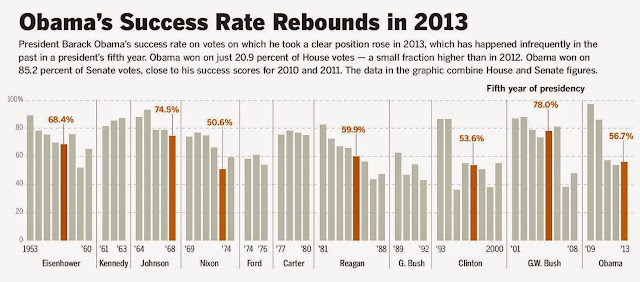
Presidential success
The Johnson Treatment:

(LBJ sightings in Frank Underwood's office)
The Johnson Network and the Johnson Intelligence System
Albert Thomas Gets It
LBJ and Halleck
The Senate roll call on the 1964 Civil Rights Act

The Johnson Treatment:
(LBJ sightings in Frank Underwood's office)
The Johnson Network and the Johnson Intelligence System
LBJ and Halleck
The Senate roll call on the 1964 Civil Rights Act
Tuesday, November 11, 2014
The Presidential Books Worth Reading
A Politico article talks about five presidential books that are interesting to read. For when we all get the time to do so, some of these sound pretty good! Carter, Eisenhower, Hoover, Grant, and Jefferson get the "worthy-to-read" book award.
http://www.politico.com/magazine/story/2014/11/presidential-books-worth-reading-112793.html#.VGLbZ4defm1
http://www.politico.com/magazine/story/2014/11/presidential-books-worth-reading-112793.html#.VGLbZ4defm1
Monday, November 10, 2014
The President and Congress
The tug-of-war between president and Congress: NAIL
- Nominations: recess appointments. And confirmation hearings not only enable senators to judge the nominees' qualifications but let them send messages to the administration. See Leahy ask Mukasey about torture. See Harkin talk to Solis about disabilities.
- Appropriations: immigration limitation riders (background)
- Investigations: executive privilege and impeachment. One famous example was the Senate Watergate Committee, in which then-staffer Fred Thompson played a role. Senator Feingold held an oversight hearing on "czars." Congress may also study executive branch operations through the GAO, the CBO, and the CRS.
- Legislation
Another Broken Promise
"I will not use signing statements to nullify or undermine congressional instructions as enacted into law." - Candidate Obama
Another instance of Obama's untruthfulness: His failure to notify Congress about Gitmo detainee transfers.
http://www.politifact.com/truth-o-meter/promises/obameter/promise/516/no-signing-statements-nullify-instruction-congress/
Another instance of Obama's untruthfulness: His failure to notify Congress about Gitmo detainee transfers.
http://www.politifact.com/truth-o-meter/promises/obameter/promise/516/no-signing-statements-nullify-instruction-congress/
Wednesday, November 5, 2014
Party Control of Congress and the Presidency
Some people were wondering about historical precedent regarding party control, divided government, etc. I found a website summarizing it here.
Neel Kashkari Election Party
Some of the members of the Claremont College Republican club had the
opportunity to go to Neel Kashkari's election party last night in Orange County. We were
invited to stand on the stage behind him as he gave his concession
speech. On stage was Libby Ramsey, Jennifer Sitton, Cameron Ridley, and
myself. It was pretty exciting for those of us who had never been on TV before.
Here's the link to a brief segment of Kashkari walking on stage and us in the background.
I believe he received about 41% of the vote last night compared to Governor Brown's 58%. Kashkari's focus for his campaign was "Jobs and Education. That's it." In his speech, Kashkari announced he was"just getting warmed up" and he challenged Gov. Brown to "be bold" his next four years.
Also, Kashkari is a huge Michael Jackson fan. MJ was playing when he walked on stage and throughout the night.

Here's the link to a brief segment of Kashkari walking on stage and us in the background.
I believe he received about 41% of the vote last night compared to Governor Brown's 58%. Kashkari's focus for his campaign was "Jobs and Education. That's it." In his speech, Kashkari announced he was"just getting warmed up" and he challenged Gov. Brown to "be bold" his next four years.
Also, Kashkari is a huge Michael Jackson fan. MJ was playing when he walked on stage and throughout the night.
Tuesday, November 4, 2014
Third Assignment
- See a day in the Ford presidency or choose a day in the George H.W. Bush presidency or Clinton presidency. Did the president use his time wisely on that day? If so, why? If not, what should he have done differently?
- Anthony Kennedy has just retired from the Supreme Court. Whom should President Obama nominate in his place? Explain, considering qualifications and confirmability.
- Identify a personnel change that you would make in the Obama administration. In other words, whom would you sack and whom would you hire in that person’s place? Explain how your proposed change would serve the president.
- Identify a policy change that President Obama could implement without Congress. What would be the legal basis for such an action? Would it be wise policy and smart politics? Explain.
- Write on a relevant question of your own choosing, subject to my approval.
- Essays should be typed (12 point), stapled, double-spaced, and no more than four pages long. I will not read past the fourth page.
- Put your name on a cover sheet. Do not identify yourself on the text pages.
- Cite your sources with endnotes. The page limit does not apply to endnote
- Watch your spelling, grammar, diction, and punctuation. Errors will count against you.
- Return essays to the Sakai dropbox by 5 PM on Friday, November 21. (Yes, you have two extra days.) Essays will drop one gradepoint for one day's lateness and a full grade for two or more days' lateness. I will grant no extensions except for illness or emergency.
Monday, November 3, 2014
White House Staff
- Inside the Obama White House
- Executive Office of the President
- All presidents worry about staff leaks. LBJ did.
- The Cabinet
Sunday, November 2, 2014
Evolution of Campaign Marketing Strategies
It is interesting to see the evolution of presidential candidates' campaigning strategies with the advent of technology. The link provides images of posters/ flyers as well as TV ads used since the 1960 election. You can view changes in web technologies - compare Clinton's 1996 website to Obama's 2012 homepage! You can also compare the improvement in Obama's campaign from 2008-2012. Obama e-cards? Nice.
http://www.4president.org/index.htm
http://www.4president.org/index.htm
Wednesday, October 29, 2014
Political Communication, Presidential Character
Q&A starts around 8:39
Skowronek and Political Time (Pika 148-149)
President’s Political
Identity
Opposed Affiliated
Prev. Vulnerable Reconstruction (FDR, Reagan) Disjunction
(Carter)
Est.
Commitment Resilient Preemption (Nixon, Clinton) Articulation (Bush
41)
-----------------------------------------------------------------------------------------------
Barber and presidential character (Pika 164-199)
Affect Toward Activity
Positive Negative
Active Adaptive (FDR) Compulsive (RN, LBJ)
Energy
Passive Compliant (Taft, Reagan) Withdrawn (Coolidge, Ike)
Monday, October 27, 2014
Political Communication II
Data:
Presidential approval and the limits of the bully pulpit.
The D-Day Speech


Bill Clinton explains "crafted speech":
The Evil Empire Speech
Presidential approval and the limits of the bully pulpit.
The D-Day Speech
Bill Clinton explains "crafted speech":
So what do I use polls for on the issues? What I primarily use polls for is to tell me how to make the argument that's most likely to persuade you that I'm right about what I'm trying to do. ... Okay. I'll give you an example where, according to the polls I have the unpopular position, okay? The Congress passes a repeal of the estate tax, an outright repeal. Now, I can--and I'm going to veto it if it comes to my desk, okay? Now, I can say the following. I can say, "I'm going to veto this because it only helps less than 2 percent of the people and half of the relief goes to one-tenth of one percent of the people, and it's an average $10 million." That is a populist explanation.
I can say, "I'm going to veto it because we only have so much money for tax cuts, and I think it's wrong to do this and say this is our highest priority, when we have done nothing to lower the income taxes of low-income working people with three kids or more or to help people pay for child care or long-term care for their elderly or disabled relatives or to get a tax deduction for college tuition."
Or I could say, "I think there should be estate tax relief." I do, by the way. "I don't care if it does help primarily upper income people. The way so many people have made so much money in the stock markets in the last 8 years, there are a lot of family-owned businesses that people would like to pass down to their family members, that would be burdened by the way the estate tax works, plus which the maximum rate is too high. When it was set, income tax rates were higher, but there was a lot of ways to get out of it. Now the rates are lower, but you have less ways to get out of it. You have to pretty much pay what you owe more." So I could say that.
So it's not fair to totally repeal it. Like even Bill Gates has said, "Why are you going to give me a $40 billion tax break." And he's going to give away his money, and I applaud him and honor him for it.
So I could make either of those three arguments. It's helpful to me to know what you're thinking. I know what I think is right. I'm not going to change what I think is right. But in order to continue to be effective, you have to believe I'm right. So that's kind of what I use polls for.
The Evil Empire Speech
The Press
Wednesday, October 22, 2014
Fireside Chats 2.0?
President Obama's use of new technology and social media differentiates him from other presidents and sets an interesting precedent for those to follow. Google Hangouts with BO - a modern day version of FDR's Fireside Chats?
http://www.msnbc.com/the-cycle/watch/obama-the-first-social-media-president-132563011874
http://www.msnbc.com/the-cycle/watch/obama-the-first-social-media-president-132563011874
Presidential Communication I
(Latin translation)
Before the rhetorical presidency
Gettysburg:
FDR Fireside Chats
The Map Speech
FDR also made speeches for newsreels:
Clinton and scandal
Wednesday, October 15, 2014

Tuesday, October 14, 2014
Second Assignment, Fall 2014
Pick one of the
following:
1. Write a Saturday radio address for
President Obama. (You may find past addresses here.) The address itself should take two
pages. Then
write a two-page essay explaining what you are trying to do in the
address. What message are you sending to what audience for what intended
effect?
3. As we have discussed in class, voters tend to pay much more attention to economics than to foreign policy and national security. But the latter can have some impact on elections. Identify a specific specific event in foreign policy and national security that purportedly affected a presidential election (e.g., the 10/31/68 announcement of a bombing halt in Vietnam). Evaluate the claims about its effect.
4. Write an essay on any relevant topic of your choice, subject to my approval.
- Whichever essay you choose, do research to document your claims. Do not write from the top of your head.
- Essays should be typed, double-spaced, and no more than four pages long. I will not read past the fourth page.
- Cite your sources with endnotes, which should be in a standard style (e.g., Turabian or Chicago Manual of Style). Endnote pages do not count against the page limit.
- Watch your spelling, grammar, diction, and punctuation. Errors will count against you.
- Turn in essays to the class Sakai dropbox by 11:59 PM, Wednesday, October 29. Late essays will drop a gradepoint for one day’s lateness, a full letter grade after that. I will grant no extensions except for illness or emergency.
Sunday, October 12, 2014
Presidential Elections and the Fundamentals
Mitt
- Supercut of Gingrich Super PAC attack ads
- But in spite of problems, he had advantages all along.
- Apple-knockers still pervade the GOP
Romney and Obama: The Polls
The Vice Presidential Candidate?
Ads? 47%? Debates? Sandy?
Fundamentals I: The Economy

Fundamentals II: Job Approval
Fundamentals III: Partisanship and Polarization
The Vice Presidential Candidate?
Ads? 47%? Debates? Sandy?
Fundamentals I: The Economy

Fundamentals II: Job Approval
Fundamentals III: Partisanship and Polarization
Wednesday, October 8, 2014
Nomination Politics
Monday, October 6, 2014
Presidential Selection Process
From Federalist 39:
The executive power will be derived from a very compound source. The immediate election of the President is to be made by the States in their political characters. The votes allotted to them are in a compound ratio, which considers them partly as distinct and coequal societies, partly as unequal members of the same society. The eventual election, again, is to be made by that branch of the legislature which consists of the national representatives; but in this particular act they are to be thrown into the form of individual delegations, from so many distinct and coequal bodies politic. From this aspect of the government it appears to be of a mixed character, presenting at least as many federal as national features.More in Federalist 68
- National Archives site on the electoral college
- History of the process
- An example: Rhode Island 2012
- Bush v. Gore. "The individual citizen has no federal constitutional right to vote for electors for the President of the United States unless and until the state legislature chooses a statewide election as the means to implement its power to appoint members of the electoral college."
- Faithless electors
- Seeking flippers
- National popular vote?
Convention moments:
Thursday, October 2, 2014
George Will: President Obama vs. Congress
"In his address about the Islamic State (which did not mention Khorasan, the asserted imminent threat that supposedly justified acting without Congress), Obama spoke to the public, not to the public’s institutional embodiment, Congress, whose support he said would be 'welcome,' implying that it is unnecessary... Obama is demonstrating in foreign policy what he has redundantly demonstrated in domestic policy—a supine Congress is superfluous to governance."
Are Congressional term limits the answer? Here is the link to the full article.
Wednesday, October 1, 2014
Reagan, Clinton, and the Bushes
Reagan


Bush 41
- Carter v. Reagan, 1980
- Economic fundamentals of the era
- 1981 Inaugural.
- INS v. Chadha
- "Tear Down This Wall"
- Iran-Contra and 1990 deposition
Deficits
Debt
Monday, September 29, 2014
The Present's Problematic Predicament for Past Presidents
Professor Pitney mentioned a while ago that Woodrow Wilson would not get away with referencing Darwin in today's political culture. When you come to think of it, many past presidents would probably perish politically in the present.
This is an interesting article about Ken Burns's documentary about the Roosevelts. Of particular relevance is the description of how TR and FDR would fare in today's political-media culture.
"We are in a media culture where we are buried in information but we know nothing," said Burns. "Because of that superficiality, we expect heroes to be perfect, but they're not. They are a strange combination of strengths and weaknesses." He points to two of his main characters as examples. "Franklin and Theodore couldn't get out of the Iowa caucuses [today]. Franklin is too infirm. CNN and Fox would be vying for the worst images of him unlocking the braces, the sweat pouring off his brow, the obvious pain and that kind of pity that it would engender would be political poison. And Theodore is just too hot for the new medium of television. There would be 10 'Howard Dean' moments a day."
And it also touches on their role in expanding presidential powers:
Bold, persistent experimentation is what FDR called it. Both Roosevelts were always on the move, clashing with the prevailing order, whether it was the party bosses or members of Congress. They often won. FDR had the Depression to create the sense of crisis that gave him free rein, but Teddy Roosevelt had no such calamity. He worried about that, saying that Lincoln would have been a forgettable president without the Civil War. Teddy had no such war, and yet we still talk about his bully pulpit and quote his aphorism about carrying a big stick when talking about presidential power. He took on the monopolies, threatened to send federal troops to operate the coal mines, and battled for the Pure Food and Drug Act and the Federal Meat Inspection Act.
Definitely worth a read-through.
Apologies for missing the past two classes -- I'll see you all on Monday!
NUF said
Ike Through Jimmy
Just before Eisenhower became president, his son John went to Korea to serve in an infantry unit. In the New York Times, the younger Eisenhower recalls a conversation that you probably never had with your dad.
In early 1961, Ike gave his Farewell Address, famously warning of the military-industrial complex. Days later, the torch passed to JFK, who took a distinctly militant tone in the Cold War. Kennedy took full advantage of new technology, starting the practice of holding press conferences on live TV. His successor, Lyndon Johnson, had an earthy way of expressing himself.
In future weeks, we shall discuss Nixon in greater detail. But this brief clip gives a glimpse of what he termed a "cold-blooded" view of international politics. President Nixon sought to rally the "silent majority" for his Vietnam policies. Also note a small chapter of actual drunk history.
As the time for my deployment approached, I discussed my intentions with my father. We met at the Blackstone Hotel in Chicago, just after the Republican convention, and I explained my position. My father, as a professional officer himself, understood and accepted it. However, he had a firm condition: under no circumstances must I ever be captured. He would accept the risk of my being killed or wounded, but if the Chinese Communists or North Koreans ever took me prisoner, and threatened blackmail, he could be forced to resign the presidency. I agreed to that condition wholeheartedly. I would take my life before being captured.Ponder that last line. A president needs a pint or two of very cold blood.
In early 1961, Ike gave his Farewell Address, famously warning of the military-industrial complex. Days later, the torch passed to JFK, who took a distinctly militant tone in the Cold War. Kennedy took full advantage of new technology, starting the practice of holding press conferences on live TV. His successor, Lyndon Johnson, had an earthy way of expressing himself.
In future weeks, we shall discuss Nixon in greater detail. But this brief clip gives a glimpse of what he termed a "cold-blooded" view of international politics. President Nixon sought to rally the "silent majority" for his Vietnam policies. Also note a small chapter of actual drunk history.
- Ford was a healer.
- Carter wore a sweater and gave the "malaise" speech.
Sunday, September 28, 2014
Yeah, I'd Be Pretty Ticked Off, Too...
In 2011, a man used a semiautomatic rifle to fire at least seven shots at the White House. It took the Secret Service four days to figure out what had happened. The Washington Post reports on the rather understandable reaction of President and Mrs. Obama:
The first lady was still upset when her husband arrived home five days later from Australia. The president was fuming, too, former aides said. Not only had their aides failed to immediately alert the first lady, but the Secret Service had stumbled in its response.
“When the president came back . . . then the s--- really hit the fan,” said one former aide.
Tensions were high when [Secret Service Director Mark] Sullivan was called to the White House for a meeting about the incident. Michelle Obama addressed him in such a sharp and raised voice that she could be heard through a closed door, according to people familiar with the exchange. Among her many questions: How did they miss bullets from an assault rifle lodged in the walls of her home?
Sullivan disputed this account of the meeting but declined to characterize the encounter, saying he does not discuss conversations with the first lady
Wednesday, September 24, 2014
FDR through Ike
Yet our distress comes from no failure of substance. We are stricken by no plague of locusts. ... Practices of the unscrupulous money changers stand indicted in the court of public opinion, rejected by the hearts and minds of men.
True they have tried, but their efforts have been cast in the pattern of an outworn tradition. Faced by failure of credit they have proposed only the lending of more money. Stripped of the lure of profit by which to induce our people to follow their false leadership, they have resorted to exhortations, pleading tearfully for restored confidence. They know only the rules of a generation of self-seekers. They have no vision, and when there is no vision the people perish.
The money changers have fled from their high seats in the temple of our civilization. We may now restore that temple to the ancient truths. The measure of the restoration lies in the extent to which we apply social values more noble than mere monetary profit.
....
In the field of world policy I would dedicate this Nation to the policy of the good neighbor—the neighbor who resolutely respects himself and, because he does so, respects the rights of others—the neighbor who respects his obligations and respects the sanctity of his agreements in and with a world of neighbors.
.... This I propose to offer, pledging that the larger purposes will bind upon us all as a sacred obligation with a unity of duty hitherto evoked only in time of armed strife.
With this pledge taken, I assume unhesitatingly the leadership of this great army of our people dedicated to a disciplined attack upon our common problems.
Action in this image and to this end is feasible under the form of government which we have inherited from our ancestors. Our Constitution is so simple and practical that it is possible always to meet extraordinary needs by changes in emphasis and arrangement without loss of essential form. That is why our constitutional system has proved itself the most superbly enduring political mechanism the modern world has produced. It has met every stress of vast expansion of territory, of foreign wars, of bitter internal strife, of world relations.
It is to be hoped that the normal balance of executive and legislative authority may be wholly adequate to meet the unprecedented task before us. But it may be that an unprecedented demand and need for undelayed action may call for temporary departure from that normal balance of public procedure.
I am prepared under my constitutional duty to recommend the measures that a stricken nation in the midst of a stricken world may require. These measures, or such other measures as the Congress may build out of its experience and wisdom, I shall seek, within my constitutional authority, to bring to speedy adoption.
But in the event that the Congress shall fail to take one of these two courses, and in the event that the national emergency is still critical, I shall not evade the clear course of duty that will then confront me. I shall ask the Congress for the one remaining instrument to meet the crisis—broad Executive power to wage a war against the emergency, as great as the power that would be given to me if we were in fact invaded by a foreign foe.
Gene Healy on Gabriel Over the White House from Cato Institute on Vimeo.
(Sorry, offensive word in the credits for the clip below.)


Tuesday, September 23, 2014

Sunday, September 21, 2014
The Presidency in the Early 20th Century
Federalist 8: "It is of the nature of war to increase the executive at the expense of the legislative authority."
Tocqueville, Democracy in America: "If the Union’s existence were constantly menaced, and if its great interests were continually interwoven with those of other powerful nations, one would see the prestige of the executive growing, because of what was expected from it and of what it did."
Darth Sidious: "We stand on the threshold of a new beginning. In order to ensure our security and continuing stability, the Republic will be reorganized into the first Galactic Empire, for a safe and secure society which I assure you, will last for ten thousand years. An empire that will continue to be ruled by this august body, and a sovereign ruler chosen for life... an empire ruled by the majority... ruled by a new constitution..."
THREE VIEWS OF PRESIDENTIAL POWER
Tocqueville, Democracy in America: "If the Union’s existence were constantly menaced, and if its great interests were continually interwoven with those of other powerful nations, one would see the prestige of the executive growing, because of what was expected from it and of what it did."
Darth Sidious: "We stand on the threshold of a new beginning. In order to ensure our security and continuing stability, the Republic will be reorganized into the first Galactic Empire, for a safe and secure society which I assure you, will last for ten thousand years. An empire that will continue to be ruled by this august body, and a sovereign ruler chosen for life... an empire ruled by the majority... ruled by a new constitution..."
THREE VIEWS OF PRESIDENTIAL POWER
Wilson and presidential power in wartime (Milkis 254-255);
Woodrow Wilson's stroke.
From Wilson's History of the American People, vol. 3.
Intertitles from The Birth of a Nation
The Harding letters and a recent news story about them
- American Protective League
- Committee on Public Information
- Espionage Act of 1917
- Sedition Act of 1918
- The Palmer Raids
Woodrow Wilson's stroke.
From Wilson's History of the American People, vol. 3.
Intertitles from The Birth of a Nation
The Harding letters and a recent news story about them
The underrated Calvin Coolidge made the first presidential speech on sound film:
Do you think Hoover was a great media president?
Wednesday, September 17, 2014
To and From the Civil War
Civil War timeline
- Lincoln letter to Albert Hodges on presidential prerogative
- Lincoln's Gettysburg Address and second inaugural
Between 1876 and 1892, no president won a majority of the popular vote:
1876 Hayes.......... 48.0*
1880 Garfield........48.3
1884 Cleveland.....48.5
1888 Harrison.......47.8*
1892 Cleveland.....46.1
*Won fewer popular votes than his main opponent.
Subscribe to:
Comments (Atom)