About this Blog

During the semester, I shall post course material and students will comment on it. Students are also free to comment on any aspect of the presidency, either current or historical. There are only two major limitations: no coarse language, and no derogatory comments about people at the Claremont Colleges.

Search This Blog

Thursday, September 24, 2009

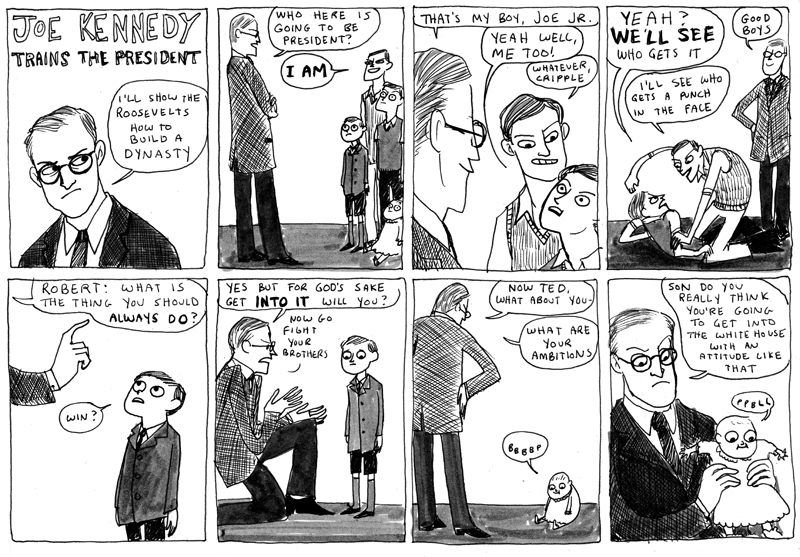
Can you tell I'm anticipating the JFK lecture


(click for bigger, readable version)

From what is possibly my favorite website, Hark! A Vagrant by Kate Beaton

Wednesday, September 23, 2009

Monday, September 21, 2009

Presidents in the Early 20th Century


Text and short video on Woodrow Wilson's stroke.

Political scientist Wilson reflects on the presidency.

The underrated Calvin Coolidge made the first presidential speech on sound film:


Do you think Hoover was a great media president?

On Today's Media Blitz

So, the President's "full Ginsburg" coincides with our readings of the Roosevelt and Wilson Presidencies.

The book emphasizes Roosevelt's relationship with the Press and his ability to utilize newspapers and magazines to pass his agenda (The Hepburn Act in particular). Milkis and Nelson state "The rise of the rhetorical presidency that began during the Roosevelt administration went hand in hand with an expansion of the executive's responsibility to guide the formation of public policy." They further emphasize Wilson's rhetorical capabilities, concluding "Henceforth presidents would be expected to articulate a vision of the future and guide the nation toward fulfilling it."

And so the President's media blitz today - hitting 4 of the 5 major Sunday morning talk shows (skipping FOX for Univision) - is as good an example as any of how Roosevelt's relationship with the Press and Wilson's use of oratory have shaped the Modern President.

But I doubt the President's efforts will have much effect. As we discussed the other day, few tune into the talk shows or Congressional addresses. If you're singing to the choir, you're not getting anyone else to stand up.

And so the question those Presidents answered - How do I reach the people with my policy message? - must have a much different answer now. Perhaps it's impossible for the President to reach the majority of Americans. While New Media campaigns work for GOTV, I question their merits in political persuasion.

Furthermore, some see the "full Ginsburg" (doesn't that sound like a potentially amazing tie knot?) as demeaning of the President. Peggy Noonan described Obama's media saturation as "boorish." And just glancing over Politico's home-page, where there are about 10 different headlines pertaining to the President ("Obama 'skeptical' about more troops," "Obama: Health Plan 'not radical'," "Job numbers bleak, says Obama," "Obama hedges on immigration timeline," "Obama Punts on ACORN Funding," "Obama: Calming 'paranoid' Russians," etc.), perhaps she's right. Perhaps the President is diluting his message by saturating the market.

But at the same time we can at least recognize his pursuit of a TR/Wilson media bump in his attempt to pass health care. And while I would bet large sums of money the President's numbers don't change in any meaningful way, I would argue it is his prerogative to see how he can preach beyond the choir. But with 100-channel cable and NFL Sunday, I doubt anything got through.

Wednesday, September 16, 2009

The Civil War and After

Civil War timeline


Between 1876 and 1892, no president won a majority of the popular vote:

1876 Hayes........... 48.0*
1880 Garfield........48.3
1884 Cleveland.....48.5
1888 Harrison.......47.8*
1892 Cleveland......46.1

*Won fewer popular votes than his main opponent.

Tuesday, September 15, 2009

Personalities and Feuds

In class yesterday, we discussed the political impact of personal conflicts and long memories. For instance, Bill Clinton's endorsement of Gavin Newsom in part reflects his bitter 1992 contest with Jerry Brown:

http://www.epicjourney2008.com/2009/09/clinton-newsom-and-brown.html

Brown played rough on other issues as well. From the New York Times (March 23, 1992):

"Mr. Clinton is presenting himself as the friend of the Afro-American community," Mr. Brown told the congregation of the Memorial Baptist Church on West 115th Street as he stood before a lighted cross. "Well, even George Bush wouldn't dare play golf at an all-white golf club."

Mr. Clinton, who has been winning more than half of the black vote in the primaries, has conceded that it was wrong for him to play golf a few times a year for several years at a whites-only club in Little Rock, Ark., and has vowed not to do it again.

Mr. Brown said that unlike most states, Arkansas does not have a state civil rights statute. He also said that in the Georgia primary campaign Mr. Clinton appeared in a newspaper photograph, standing in a prison before a group of inmates, all of them black."What's the message of that?" Mr. Brown asked the congregation, which interrupted with applause and shouts of "yes!" and "amen!" "He's saying: 'We have them under control, folks. Don't worry.' "

Party leaders give Mr. Brown little chance of winning the nomination, fearing his only role now could be to weaken Mr. Clinton and thereby help President Bush.
Mr. Brown said in an interview that he resented such talk, adding: "What is this, the Politburo? There is only the candidate picked by the power structure?"

"I'm not the spoiler," he continued. "Slick Willie's the spoiler. If he gets the nomination, he's going to ruin the whole Democratic Party."