Here are some answers to recent questions that have come up in class:
1. Milkis and Nelson are not quite accurate when they speak of "a signficiant reduction in domestic spending" under Reagan (p. 370). In constant FY2000 dollars, there was a drop in nondefense discretionary spending, from $282.1 billion in FY81 to $255.3 billion in FY89. But more than offsetting this change were large increases in other areas of domestic spending:
...............................FY81......FY89
Social Security.......$246b....$300b
Means-Tested
Entitlements (for
the needy)..............$93b.......$111b
2. Here is the formula for the Major Party Index (MPI): ((Most recent 2-Party Republican Presidential Vote)*0.25) + ((Average of the Two Most Recent Republican 2-Party Votes for the U.S. Senate)*0.125) + ((Republican 2- Party Percent of all U.S. House Votes)*0.125) + ((Most Recent 2-Party Republican Vote for Governor)*0.25) + ((2-Party Republican Percentage of Seats in the State Senate)*0.125) + ((2-Party Republican Percentage of Seats in the State House)*0.125). More detail here.
3. In 1976, the first year for which we have FEC data, all presidential candidates in both parties raised a total of $171 million in the primary and general election campaigns. That amount equals $647 million in 2008 dollars (CPI). The latest figures show that Barack Obama raised $656 million in 2008. In other words, he raised more money than all of the 1976 candidates put together.
Monday, October 5, 2009

More Gallup Polls
During today's examination of party identification I remembered Nate Silver's piece about coming of age during different Presidential administrations.
Mr. Silver argues:


Mr. Silver argues:
What's interesting, though, is what happens when we look at not these abstract generational categories, but rather at the following question: who was President when you turned 18? As annotated in the chart below, the popularity -- or lack thereof -- of the President when the voter turned 18 would seem to have a lot of explanatory power for how their politics turned out later on.


Wednesday, September 30, 2009
Recent Presidents
- Carter wore a sweater.
- Reagan was a stronger communicator.
- Clinton, alas, will go down for an unfortunate phrase.
Monday, September 28, 2009
Ike Through Carter
Just before Eisenhower became president, his son John went to Korea to serve in an infantry unit. In the New York Times, the younger Eisenhower recalls a conversation that you probably never had with your dad.
As the time for my deployment approached, I discussed my intentions with my father. We met at the Blackstone Hotel in Chicago, just after the Republican convention, and I explained my position. My father, as a professional officer himself, understood and accepted it. However, he had a firm condition: under no circumstances must I ever be captured. He would accept the risk of my being killed or wounded, but if the Chinese Communists or North Koreans ever took me prisoner, and threatened blackmail, he could be forced to resign the presidency. I agreed to that condition wholeheartedly. I would take my life before being captured.
Ponder that last line. A president needs a pint or two of very cold blood.
In early 1961, Ike gave his Farewell Address, famously warning of the military-industrial complex. Days later, the torch passed to JFK, who took a distinctly militant tone in the Cold War. Kennedy took full advantage of new technology, starting the practice of holding press conferences on live TV. His successor, Lyndon Johnson, had an earthy way of expressing himself.
In future weeks, we shall discuss Nixon in greater detail. But this brief clip gives a glimpse of what he termed a "cold-blooded" view of international politics. President Nixon sought to rally the "silent majority" for his Vietnam policies.
- Ford was a healer.
- Carter wore a sweater.
Thursday, September 24, 2009
Can you tell I'm anticipating the JFK lecture
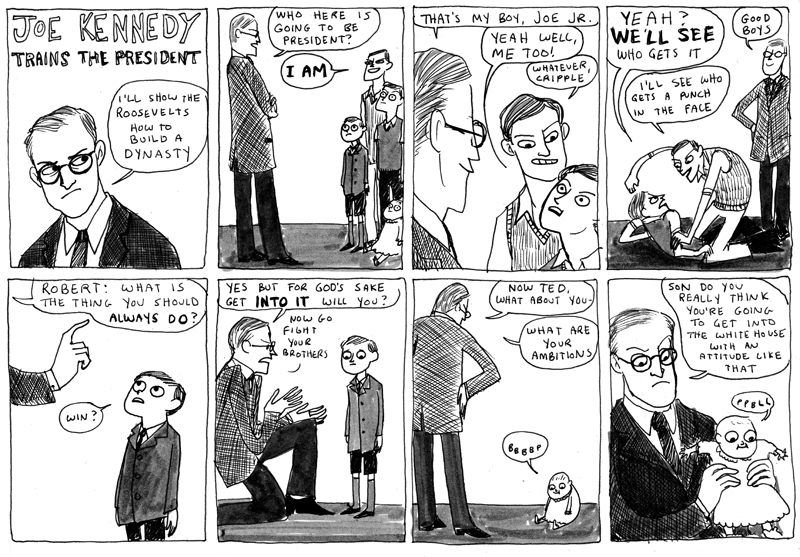
(click for bigger, readable version)
From what is possibly my favorite website, Hark! A Vagrant by Kate Beaton
Subscribe to:
Posts (Atom)